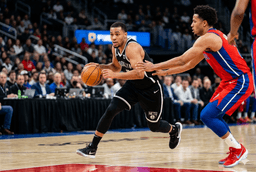
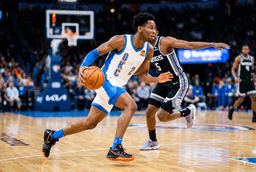
Basketball Rules: What is a Backcourt Violation?
Basketball is a fast and strategic game, and understanding the court is important. Dribbling and shooting are easy to spot, but the rules shape how the game is played. Learning these rules helps players and gives fans a better understanding.
A backcourt violation is a common call that stops play and gives the ball to the other team. It happens when the offense, after taking control in the frontcourt, sends the ball back to their own half. The rule sounds simple, but the details can be confusing. Understanding it helps players avoid turnovers and keep their offense moving.
Defining Frontcourt and Backcourt
To understand this rule, you first need to know the court’s two main areas, which depend on which team has the ball:
• Frontcourt: The frontcourt is the half of the court that contains the opposing team’s basket (the basket your team is trying to score on).
• Backcourt: The backcourt is the half of the court that contains your team’s basket and the free-throw lane.
The line separating these two areas is called the midcourt line, also known as the ten-foot line.
Establishing the Sequence
A backcourt violation is not just one action, but a sequence of events. Three things must happen before the referee calls it:
1. First: the offense must gain 'frontcourt status' for the ball, which can happen in 2 ways.
• Ball and Player: A player, while both they and the ball are in the frontcourt, has possession.
• A player gets frontcourt status only when both their feet and the ball have crossed the midcourt line while dribbling.
2. Second, the offensive player who gained frontcourt status, or one of their teammates, must be the last to touch the ball. This does not mean the ball has gone into the backcourt; it just means the offense touched it last.
3. Third, after the offense touches the ball, it must cross back over the midcourt line into the backcourt.
A backcourt violation only happens if all three steps take place.
Common Backcourt Scenarios
Referees have to make quick decisions about backcourt violations. Here are some common situations where these calls happen:
• If a player brings the ball over midcourt, they cannot pass it back to a teammate who is still behind the line. This is a clear violation.
• Sometimes, an offensive player in the frontcourt loses control of the ball under pressure. If the last person to touch it before it goes into the backcourt is from the offense, and another offensive player picks it up there, it counts as a violation.
• Defenders often trap a player near midcourt. If the offense has both feet and the ball over the line, but then steps or dribbles back, that is a violation.
Understanding Key Exceptions
Like many basketball rules, there are some exceptions where something that looks like a violation is actually allowed:
• The main exception is during the opening tip-off. After the first jump, the ball is neutral. A player who catches the tipped or loose ball can land in either half, since neither team has possession yet.
• During a frontcourt throw-in, players can pass the ball to the backcourt, and a teammate can catch it there. The violation only applies after a team has established possession on the court.
• If the defense steals the ball, they become the offense and can take possession in either half. The rule starts over based on their new frontcourt status.
Navigating the Midcourt Line
Learning the backcourt rules is important for smart basketball. The midcourt line is not just a marking, but a key spot for strategy. Offenses need to move forward, set up in the frontcourt, and avoid mistakes that give up the ball. Defenses use pressure at midcourt to force errors. Knowing these rules helps teams make fewer mistakes and keep control.
TigerScores is your ultimate multi-sport hub, delivering the latest scores, in-depth stats, and breaking news from the world of professional sports. Whether you're tracking league standings or looking for real-time game updates, our platform ensures you stay ahead of every play.


Mbappe 2026 Stats: A Look at His Ballon d'Or Run
North Division Dominance: Assessing the MPBL Power Rankings
WNBA Rookie Watch: 5 Standouts Poised to Start
The 10 Most Iconic Champions League Semi-Finals
The High-Stakes Bundesliga Relegation Race
Tactical Breakdown: A Look at the 2026 PVL Semifinals
The Truth Behind Haaland Transfer Rumors
Wembanyama Playoff Stats: Predicting His Postseason Impact
Understanding NBA Hard Cap Rules: A 2026 Guide
Icons of the Hardcourt: Top PBA Finals Imports